Policy template
Diversity, Equity and Inclusion Policy Template
A prompt-based template for Seed to Series B companies
What is a Diversity, Equity and Inclusion policy?
A DEI policy sets out how your business approaches diversity, equity and inclusion. Diversity is about representation across different groups and ways of thinking. Equity is about fair treatment and access to opportunity, recognising that people start from different positions. Inclusion is about creating a culture where everyone can contribute and feel they belong.
DEI is both a values commitment and a commercial one. Companies that get this right attract better candidates from a wider pool, make better decisions, retain people for longer, and reach more customers. The policy is mainly an internal tool to guide decisions and signal what your team can expect from each other and from the company. Treat it as a living document that grows with your company.
Start with materiality
Early-stage priorities differ. A team of fifteen needs to focus on hiring, culture-setting and pay practices. A team of one hundred needs structured promotion processes, manager training and pay gap analysis. Pick the prompts below that are most relevant to where you are now.
Topics to consider when drafting
- Inclusive hiring practices (diverse recruitment funnel, structured interviews, diverse panels, removing biased criteria)
- Use of AI in hiring (what is automated, what data is used, how bias is monitored)
- Pay equity, pay transparency and salary ranges in job postings
- Pay gap reporting (gender, and ethnicity where lawful)
- Parental leave and family-friendly policies
- Flexible and remote working
- Inclusion and reasonable adjustments for disability, neurodiversity, religious and cultural observance, LGBTQ+
- Mental health support and wellbeing
- Promotion and progression criteria
- Manager training on inclusive leadership
- Connection to your Anti-Harassment & Discrimination policy
Example Template
Introduction / DEI Statement:
Define why DEI is important to your company and how it relates to your overall mission and vision. Describe your commitments to DEI and which initiatives you feel are key priorities for your business.
Purpose / Scope of policy:
Describe the objective of the policy and who it applies to. For example: the policy outlines your commitment to DEI and serves as a guide for employees, suppliers and other stakeholders as relevant.
-
Recruitment, hiring and onboarding
What initiatives are in place to build a diverse pipeline and reduce bias in hiring (structured interviews, diverse panels, blind CV review, removing degree requirements where appropriate)? How do you onboard new joiners inclusively? Where you use AI tools in hiring, what bias and fairness checks are in place? -
Pay, benefits and pay transparency
How do you ensure fair and equal pay? Do you publish salary ranges in job postings? Do you analyse pay gaps (gender, and ethnicity where lawful) and act on findings? What benefits support a diverse workforce (parental leave for all parents, flexible working, mental health support)? -
Training, development and progression
How do you manage performance and progression fairly? What training is offered (skills, manager training, inclusion training)? What criteria determine readiness for promotion? Do you set representation targets at senior levels? -
Workplace accessibility and inclusion
How is your physical and digital workplace accessible and inclusive to all? What is your process for reasonable adjustments (religious holidays, dietary needs, prayer space etc.)? Do you offer flexible or remote working, and how is it managed fairly? -
Culture, communication and feedback
What does an inclusive culture look like in practice for your company? How do you measure inclusion (engagement surveys, exit data, representation at different levels)? How often do you review it? What channels do employees have to raise concerns or give feedback (anonymously and openly)? -
Health, safety and wellbeing
What practices and benefits support physical and mental wellbeing? How is this communicated and monitored? -
Prevention of harassment, bullying and discrimination
Do you have an Anti-Harassment and Discrimination policy? How do you safeguard against these behaviours? How is it monitored?
Policy adherence:
All employees should be required to read the policy and confirm they have understood it.
Policy approval: Who is accountable for the DEI policy day to day? Who is the senior sponsor? How often will it be reviewed and updated (annually as a minimum)?
How to embed this policy
Drafting this policy is the start, not the finish. Use these prompts to make it real:
- Where will the policy live so employees can find it (handbook, intranet, shared drive)?
- How will it be introduced (onboarding, all-hands, training)?
- Who owns it day to day, and who is the escalation point?
- How often will it be reviewed and refreshed (annually as a minimum)?
- How will employees confirm they have read and understood it?
- How will it be communicated to suppliers, customers, and other relevant third parties?
How this policy connects
This policy works alongside others. Cross-reference where helpful:
- Code of Conduct (overarching behaviour and ethics)
- Anti-Harassment & Discrimination policy (protecting against unwanted behaviours)
- Whistleblowing policy (raising concerns)
- Sustainability policy (environment, social and governance)
Disclaimer: All templates and information provided by Atomico (UK) Partners LLP in this report are for reference only. The templates are subject to copyright but are provided for free public use. No representations or warranties of any kind, express or implied, are made about the completeness, accuracy, reliability, suitability or availability with respect to the report or the templates or information in the report. Any reliance you place on such information or template is strictly at your own risk. To the fullest extent permitted under applicable law, Atomico (UK) Partners LLP and its affiliates disclaim any implied or statutory warranty, including any implied warranty of title, non-infringement or fitness for a particular purpose in respect of the templates and information.
Other policy templates
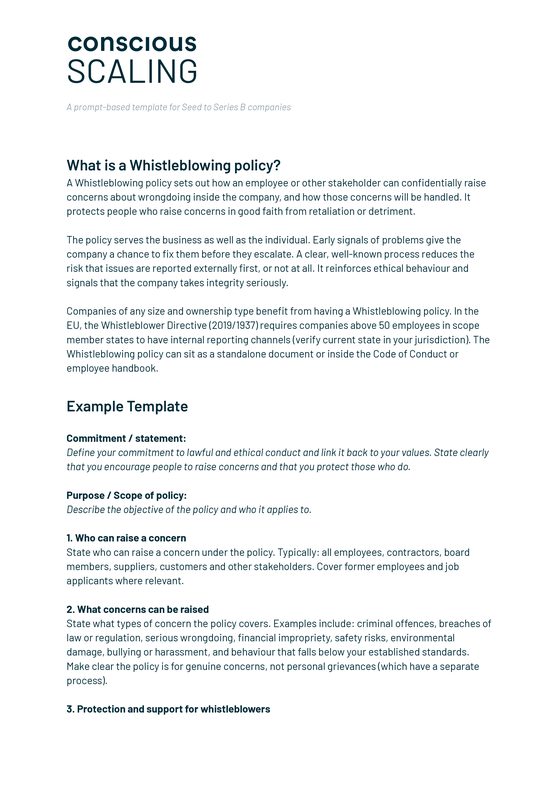
Whistleblowing Policy Template
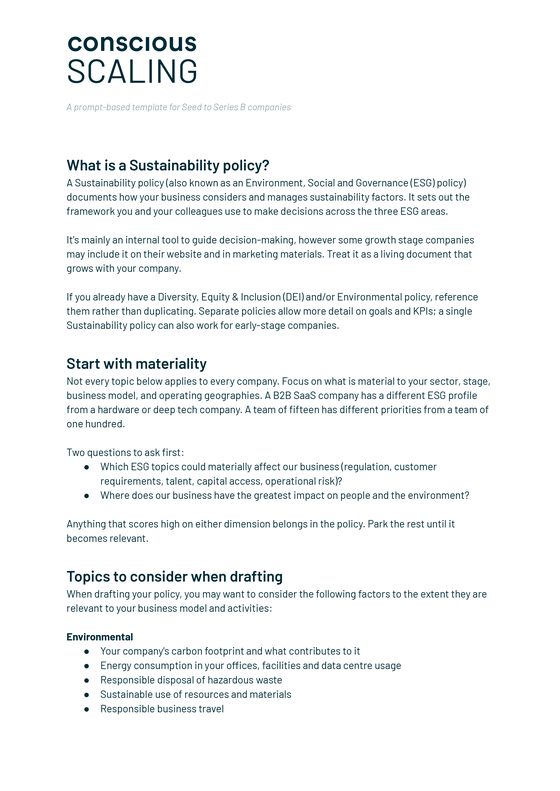
View templateSustainability Policy Template
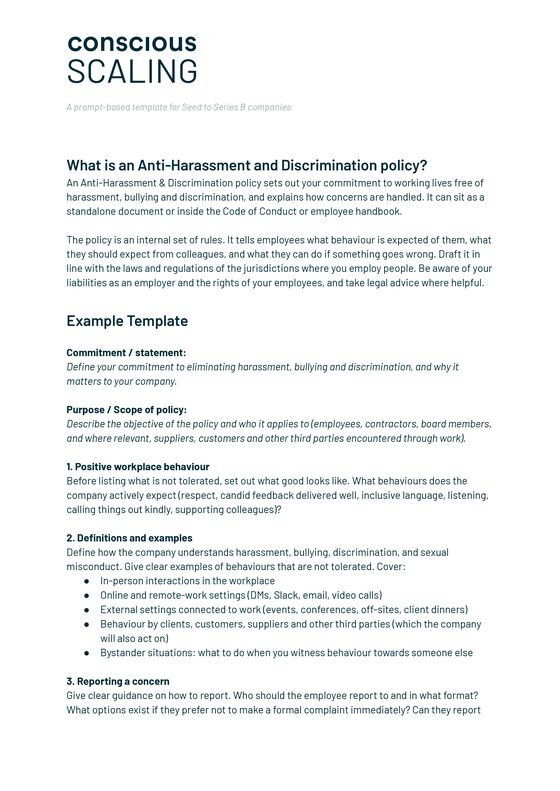
View templateAnti-Harassment & Discrimination Policy Template
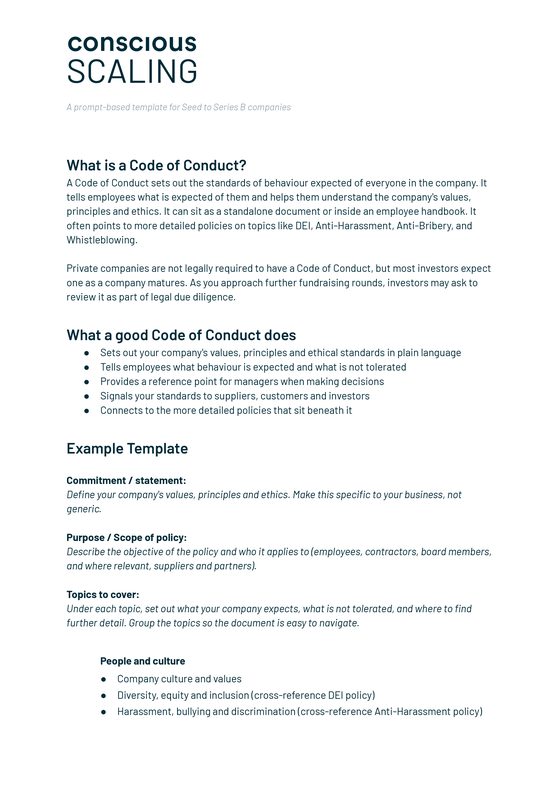
View templateCode of Conduct Template
View template