Policy template
Anti-Harassment & Discrimination Policy Template
A prompt-based template for Seed to Series B companies
What is an Anti-Harassment and Discrimination policy?
An Anti-Harassment & Discrimination policy sets out your commitment to working lives free of harassment, bullying and discrimination, and explains how concerns are handled. It can sit as a standalone document or inside the Code of Conduct or employee handbook.
The policy is an internal set of rules. It tells employees what behaviour is expected of them, what they should expect from colleagues, and what they can do if something goes wrong. Draft it in line with the laws and regulations of the jurisdictions where you employ people. Be aware of your liabilities as an employer and the rights of your employees, and take legal advice where helpful.
Example Template
Commitment / statement:
Define your commitment to eliminating harassment, bullying and discrimination, and why it matters to your company.
Purpose / Scope of policy:
Describe the objective of the policy and who it applies to (employees, contractors, board members, and where relevant, suppliers, customers and other third parties encountered through work).
1. Positive workplace behaviour
Before listing what is not tolerated, set out what good looks like. What behaviours does the company actively expect (respect, candid feedback delivered well, inclusive language, listening, calling things out kindly, supporting colleagues)?
2. Definitions and examples
Define how the company understands harassment, bullying, discrimination, and sexual misconduct. Give clear examples of behaviours that are not tolerated. Cover:
- In-person interactions in the workplace
- Online and remote-work settings (DMs, Slack, email, video calls)
- External settings connected to work (events, conferences, off-sites, client dinners)
- Behaviour by clients, customers, suppliers and other third parties (which the company will also act on)
- Bystander situations: what to do when you witness behaviour towards someone else
3. Reporting a concern
Give clear guidance on how to report. Who should the employee report to and in what format? What options exist if they prefer not to make a formal complaint immediately? Can they report
anonymously? Cross-reference the Whistleblowing policy where relevant.
- Direct line manager
- An alternative manager or senior leader if the line manager is involved
- HR or People team
- An independent third-party reporting line, where the company has one
4. How the company will respond
Explain the process the company follows to investigate and act on reports. Set out:
- Communication and timelines the complainant can expect
- Confidentiality of the process and who has access to information
- What support is available during the process (HR contact, employee assistance programme, time off if needed)
- What protections are in place against retaliation
- Reasonable adjustments that may be put in place during an investigation
- The company's position on non-disclosure agreements in the context of harassment complaints
5. If you have been accused of harassment, bullying or discrimination
What process will be followed? What support is available? What outcomes are possible? What should you expect during the investigation? What are your rights?
6. How the company ensures the policy is upheld
Who is responsible for the policy? How are records kept and reviewed for patterns over time? What training is provided to employees and managers, and how often (initial and refresher)? Where the company employs people in multiple jurisdictions, how are differing legal definitions reflected?
7. Review and continuous improvement
How is the policy reviewed and updated (annually as a minimum, or following any incident)? How is feedback from employees on the policy and process gathered and acted on?
Policy adherence:
All employees should be required to read the policy and confirm they have understood it.
Policy approval: Who is accountable for this policy day to day? Who is the senior sponsor? How often will it be reviewed and updated (annually as a minimum)?
How to embed this policy
Drafting this policy is the start, not the finish. Use these prompts to make it real:
- Where will the policy live so employees can find it (handbook, intranet, shared drive)?
- How will it be introduced (onboarding, all-hands, training)?
- Who owns it day to day, and who is the escalation point?
- How often will it be reviewed and refreshed (annually as a minimum)?
- How will employees confirm they have read and understood it?
- How will it be communicated to suppliers, customers, and other relevant third parties?
How this policy connects
This policy works alongside others. Cross-reference where helpful:
- Code of Conduct (overarching behaviour and ethics)
- DEI policy (recruitment, fair treatment, inclusion)
- Whistleblowing policy (raising concerns)
- Sustainability policy (environment, social and governance)
Disclaimer: All templates and information provided by Atomico (UK) Partners LLP in this report are for reference only. The templates are subject to copyright but are provided for free public use. No representations or warranties of any kind, express or implied, are made about the completeness, accuracy, reliability, suitability or availability with respect to the report or the templates or information in the report. Any reliance you place on such information or template is strictly at your own risk. To the fullest extent permitted under applicable law, Atomico (UK) Partners LLP and its affiliates disclaim any implied or statutory warranty, including any implied warranty of title, non-infringement or fitness for a particular purpose in respect of the templates and information.
Other policy templates
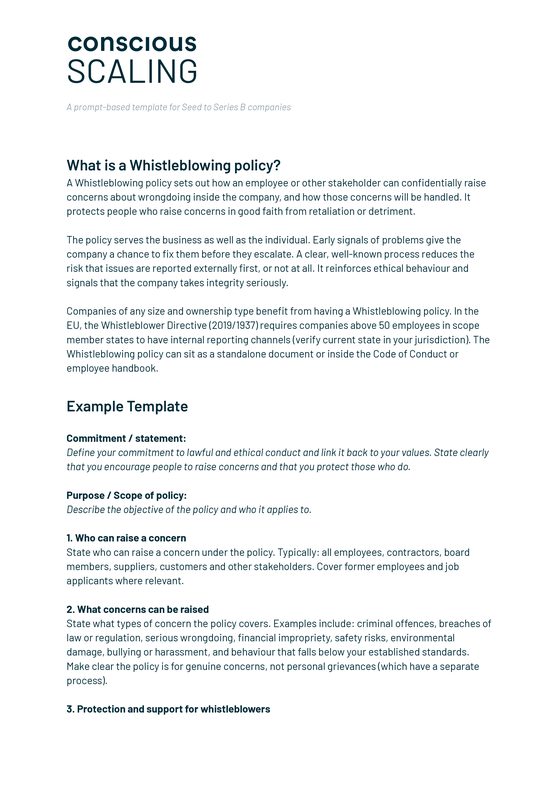
Whistleblowing Policy Template
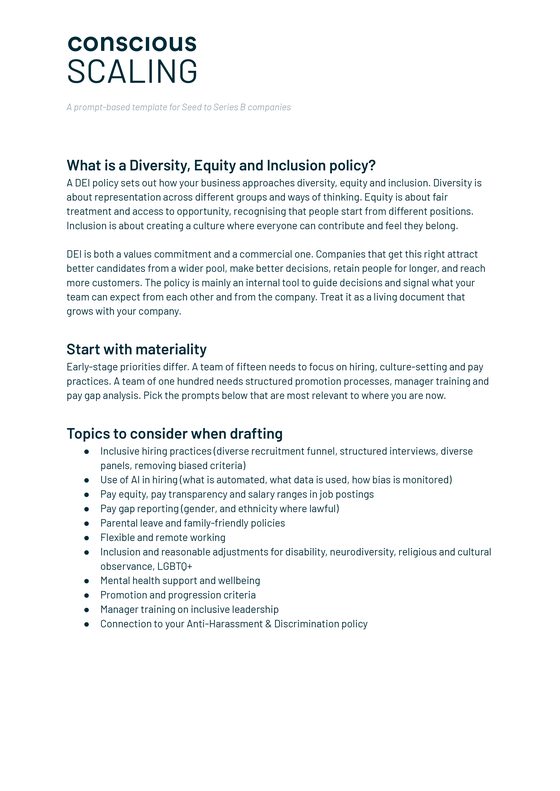
View templateDiversity, Equity and Inclusion Policy Template
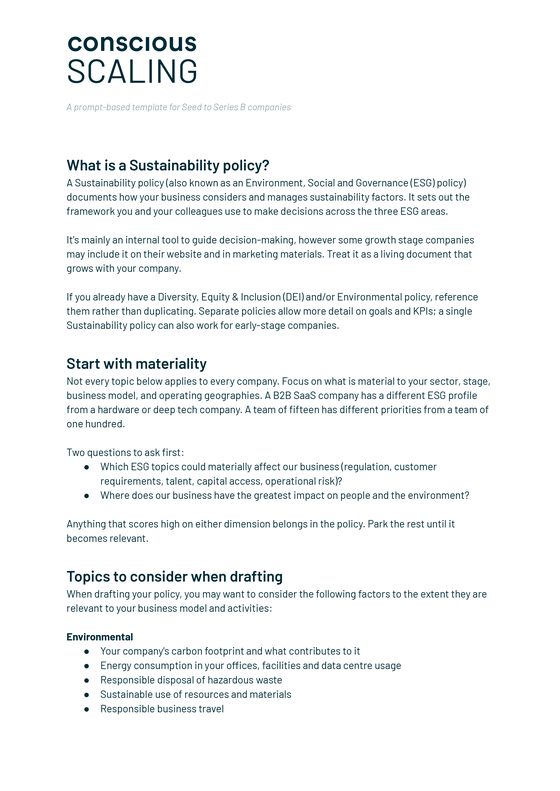
View templateSustainability Policy Template
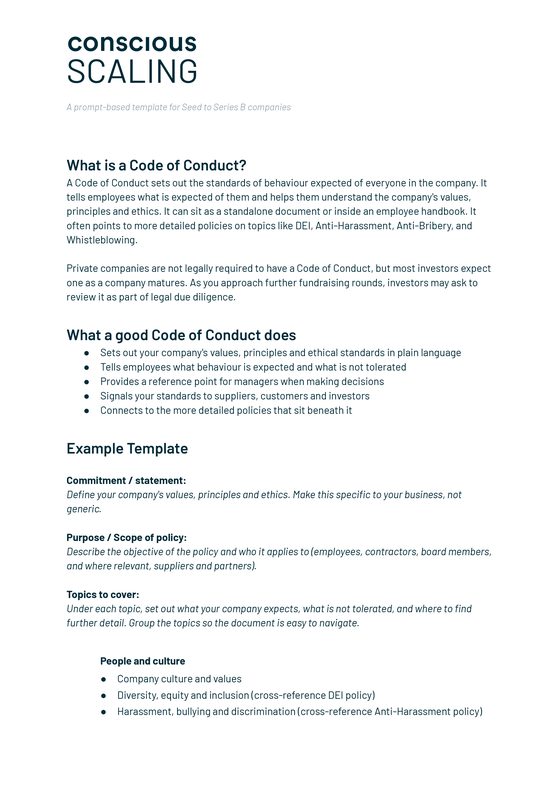
View templateCode of Conduct Template
View template