Policy template
Code of Conduct Template
A prompt-based template for Seed to Series B companies
What is a Code of Conduct?
A Code of Conduct sets out the standards of behaviour expected of everyone in the company. It tells employees what is expected of them and helps them understand the company's values, principles and ethics. It can sit as a standalone document or inside an employee handbook. It often points to more detailed policies on topics like DEI, Anti-Harassment, Anti-Bribery, and Whistleblowing.
Private companies are not legally required to have a Code of Conduct, but most investors expect one as a company matures. As you approach further fundraising rounds, investors may ask to review it as part of legal due diligence.
What a good Code of Conduct does
- Sets out your company's values, principles and ethical standards in plain language
- Tells employees what behaviour is expected and what is not tolerated
- Provides a reference point for managers when making decisions
- Signals your standards to suppliers, customers and investors
- Connects to the more detailed policies that sit beneath it
Example Template
Commitment / statement:
Define your company's values, principles and ethics. Make this specific to your business, not generic.
Purpose / Scope of policy:
Describe the objective of the policy and who it applies to (employees, contractors, board members, and where relevant, suppliers and partners).
Topics to cover:
Under each topic, set out what your company expects, what is not tolerated, and where to find further detail. Group the topics so the document is easy to navigate.
People and culture
- Company culture and values
- Diversity, equity and inclusion (cross-reference DEI policy)
- Harassment, bullying and discrimination (cross-reference Anti-Harassment policy)
- Conduct in the workplace, including online and remote settings
- Personal relationships at work
- Substance use
- Health, safety and wellbeing
Integrity
- Conflicts of interest
- Misuse of position or company assets
- Bribery and corruption
- Anti-money laundering
- Insider information and market abuse (most relevant pre-IPO)
- Whistleblowing and how to raise concerns (cross-reference Whistleblowing policy)
Business conduct
- Working with customers and suppliers (ethical sourcing, fair dealing)
- Modern slavery and human trafficking
- Human rights and labour rights
- Trade sanctions and export controls (where relevant for your sector)
- Fair competition and antitrust
- Reporting and regulatory compliance
- Environmental conduct (cross-reference ESG policy)
Information and technology
- Data protection and privacy
- Cybersecurity and information security
- Acceptable use of company devices, networks and systems
- Use of AI tools (acceptable use, confidentiality of inputs, IP risk, accuracy of outputs)
- Social media conduct (representing the company, personal accounts, confidentiality)
- Intellectual property and protection of company assets
Policy adherence:
All employees should be required to read the Code of Conduct and confirm they have understood it. Where appropriate, suppliers and key partners should also receive a copy or be asked to sign up to a parallel supplier code.
Policy enforcement:
Set out the disciplinary process for failures to comply, and the steps that will be followed. Explain how employees can report a breach (formally, informally, anonymously). Make clear that retaliation against anyone raising a concern in good faith will not be tolerated.
Policy approval:
Who is responsible for the policy? Who enforces it? How is it monitored, and how are records kept? How often is it reviewed (annually as a minimum)?
How to embed this policy
Drafting this policy is the start, not the finish. Use these prompts to make it real:
- Where will the policy live so employees can find it (handbook, intranet, shared drive)?
- How will it be introduced (onboarding, all-hands, training)?
- Who owns it day to day, and who is the escalation point?
- How often will it be reviewed and refreshed (annually as a minimum)?
- How will employees confirm they have read and understood it?
- How will it be communicated to suppliers, customers, and other relevant third parties?
How this policy connects
This policy works alongside others. Cross-reference where helpful:
- DEI policy (recruitment, fair treatment, inclusion)
- Anti-Harassment & Discrimination policy (protecting against unwanted behaviours)
- Whistleblowing policy (raising concerns)
- Sustainability policy (environment, social and governance)
Disclaimer: All templates and information provided by Atomico (UK) Partners LLP in this report are for reference only. The templates are subject to copyright but are provided for free public use. No representations or warranties of any kind, express or implied, are made about the completeness, accuracy, reliability, suitability or availability with respect to the report or the templates or information in the report. Any reliance you place on such information or template is strictly at your own risk. To the fullest extent permitted under applicable law, Atomico (UK) Partners LLP and its affiliates disclaim any implied or statutory warranty, including any implied warranty of title, non-infringement or fitness for a particular purpose in respect of the templates and information.
Other policy templates
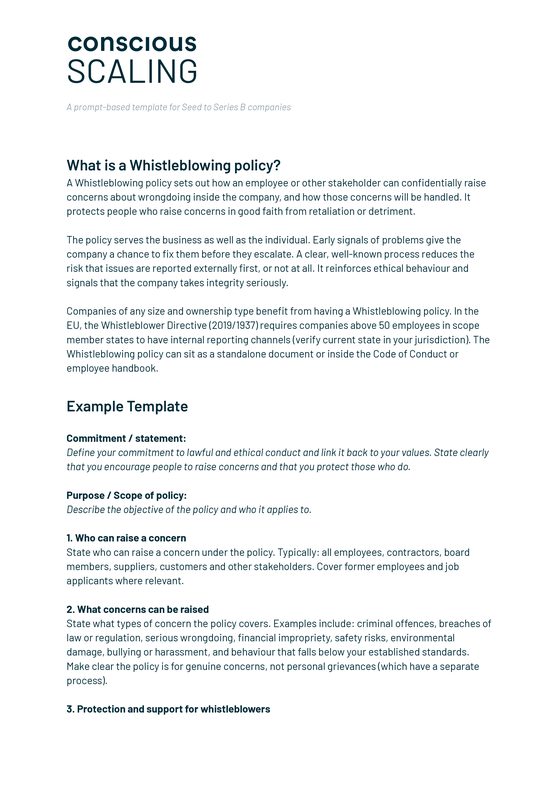
Whistleblowing Policy Template
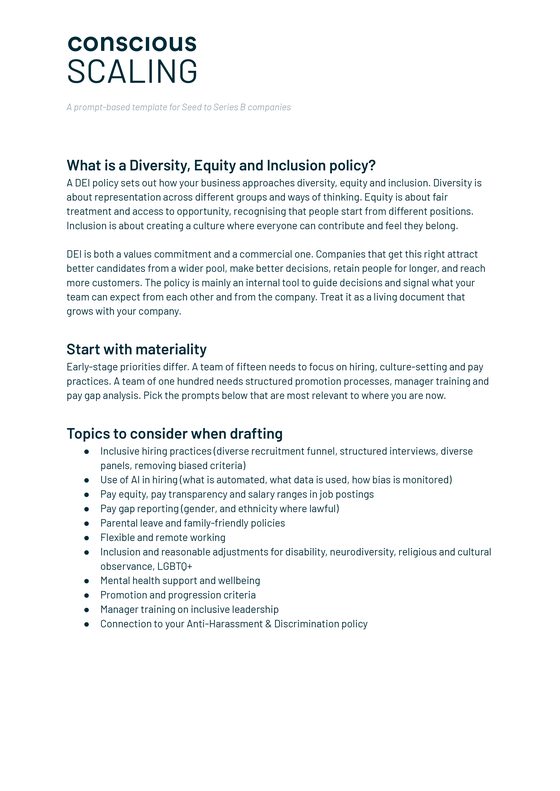
View templateDiversity, Equity and Inclusion Policy Template
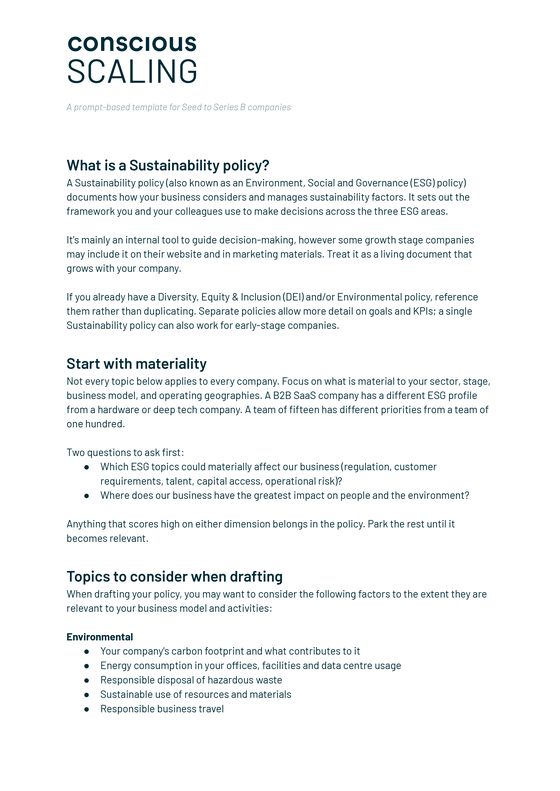
View templateSustainability Policy Template
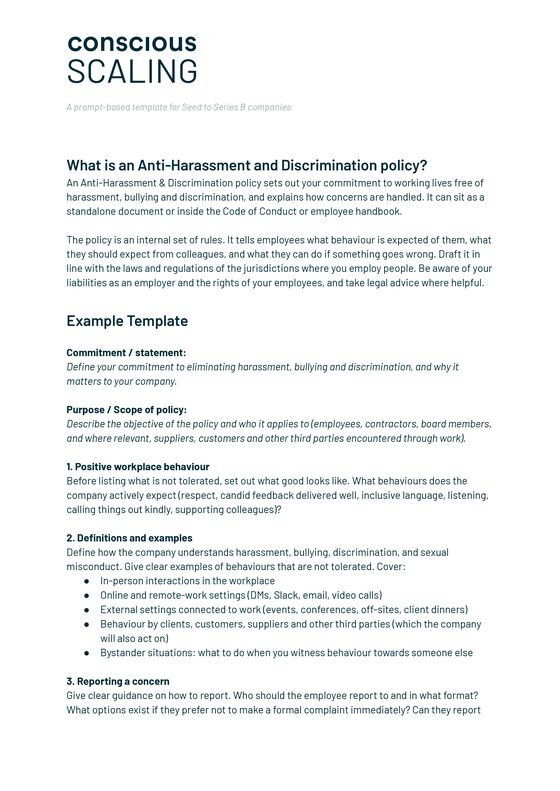
View templateAnti-Harassment & Discrimination Policy Template
View template